Maharashtra's DELTA Act: what it means for your project (for now, nothing)
If you follow real-estate news, your feed spent the last two days telling you that Maharashtra is about to put land on the blockchain. Some of the coverage made it sound like the law had passed.
It hasn't. Here is what actually happened, and what it changes for a developer selling under-construction flats in Nashik or Thane. The short answer is: this year, nothing. But the reason it's nothing is worth understanding, because it tells you what this is really about.
What was actually announced
On Monday, 20 July, Chief Minister Devendra Fadnavis chaired a meeting at Sahyadri Guest House on a draft of the Maharashtra Digitisation and Exchange of Land Token Asset Act, or DELTA. MoS Madhuritai Misal was present.
Two directions came out of that meeting. Officials were asked to prepare the legislation, and the Urban Development and Law & Judiciary departments were asked to form an expert committee to write the framework. The stated goals were legal certainty, transparency, protection of ownership rights, and faster property transactions, set against the state's target of a one-trillion-dollar economy by 2030.
That's the whole event. There is no bill. The committee that will write the framework has not been formed yet, so nobody has drafted a clause. No date was given for any of it. Officials were also asked to first study how other countries handle this, which is not usually a sign that something lands next quarter.
I'm not saying that to be dismissive. A state taking property digitisation seriously is good news in a country where title verification still eats months of everyone's life. I'm saying it because several vendors will call you this quarter about getting "DELTA ready", and there is currently nothing to be ready for.
Read the committee, not the press release
The most informative line in the announcement isn't about blockchain. It's who gets a seat.
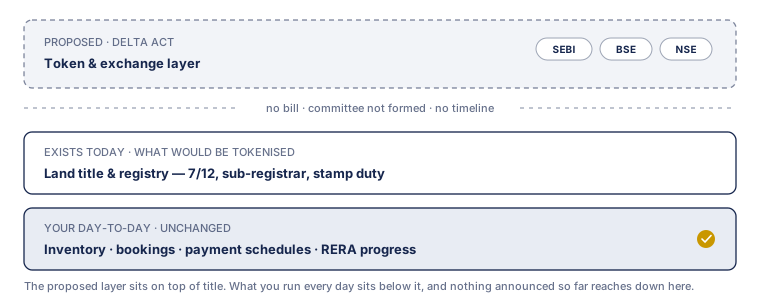
The committee is to include representatives from SEBI, the BSE and the NSE. Those are securities regulators and stock exchanges. You don't invite them to reform how a sub-registrar stamps a document. You invite them when the thing you're building is an instrument that people will buy, sell and hold in fractions.
So the likely shape of this is a market for fractional interests in property value, with land as the underlying asset. That fits the language the CM used about mortgage financing and about owners realising value sitting idle in their property.
It's a landowner-and-investor reform. It is not a change to how you register a phase, file a QPR, or collect a construction-linked instalment.
The rule that actually decides this
Here's the part I found most useful, and it has nothing to do with the DELTA Act.
Fractional ownership of real estate in India already has a legal route. SEBI notified it in March 2024 as Small and Medium REITs. A scheme needs assets between ₹50 crore and ₹500 crore and at least 200 investors. And it carries one condition that matters enormously to you: at least 95% of a scheme's assets must be in completed, revenue-generating property.
SEBI is blunter than that, in fact: an SM REIT scheme cannot invest in under-construction or non-revenue-generating real estate at all. The rule exists because the earlier generation of fractional platforms sold people slices of projects that then ran late, and SEBI decided investors shouldn't carry construction risk in a retail product.
Read it against your business. If you sell under-construction residential flats, your inventory is by definition neither completed nor revenue-generating. It sits outside the one lawful fractional route India currently has.
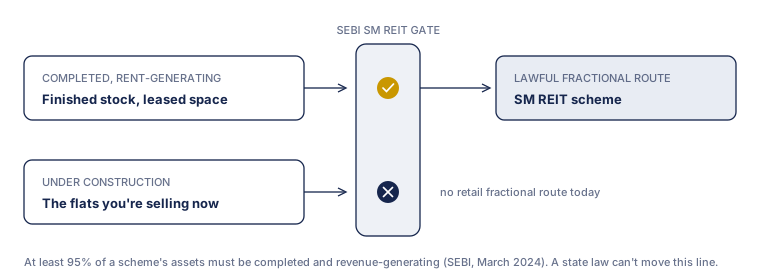
A state law can't move that boundary. Securities regulation is central. Maharashtra can build the registry, define what a token means in state law, and sort out stamp duty treatment. Whether your under-construction inventory can be sold in fractions to the public is SEBI's call, and SEBI has already answered it for now.
That's why I think this genuinely doesn't touch your operations for a while, and why I'd be suspicious of anyone selling you urgency.
Three ways it could still reach you
Not this year. But these are the channels worth watching.
Completed inventory is a different story. If you're sitting on unsold finished stock, or you hold commercial space that earns rent, a fractional or tokenised route is more plausible for you than for a builder mid-slab. Worth watching rather than acting on.
Land aggregation could change before sales do. If tokenised land makes it easier for a landowner to borrow against a parcel or sell part of it, that affects what joint-development terms look like and what a plot costs you. That's the channel I'd expect to feel first, and it's on the buying side, not the selling side.
And the registry could arrive before the market does. If Maharashtra builds a clean digital property register as scaffolding for all this, that's useful on its own, whatever happens to the token part.
What to do on Monday
Nothing, mainly. Read the committee's terms of reference when they're published, because that will tell you far more than any of this week's coverage. If you're in CREDAI, the consultation stage is when a trade body is actually worth its subscription.
The only durable point is a boring one. Every version of this ends with somebody outside your office needing to verify what you own, what's sold, what's collected against it, and what's built. That's already true when a bank does due diligence, when RERA asks for a quarterly progress report, or when a buyer's lawyer starts asking questions before handover. Developers who can answer those questions in an afternoon do better than developers who can't, and they'd do better in a world with no DELTA Act at all.
Sources
- The 20 July meeting and the CM's statement, as reported by Free Press Journal and Deccan Herald
- The ₹50 crore to ₹500 crore, 200-investor and 95% revenue-generating conditions: SEBI's official SM REIT FAQ (the REIT Regulations were amended to add the SM REIT framework on 8 March 2024)
This is commentary, not legal or investment advice. Nothing above is a settled position; the law doesn't exist yet.