Blog

Occasional writing on Indian real-estate rules, RERA filings and the software problems underneath them. Written by the person who builds Construvex.
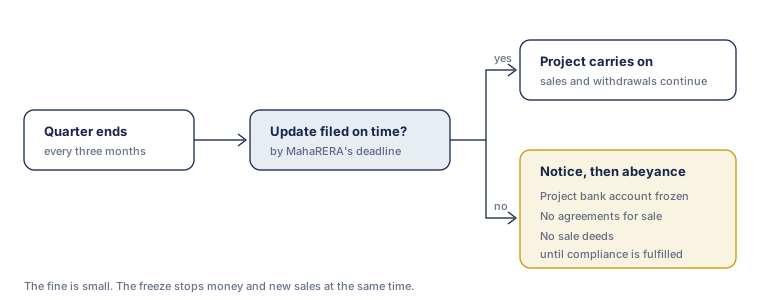
A decision fork. Each quarter ends and the question is whether the quarterly update was filed on time. If yes, the project carries on. If no, MahaRERA sends a notice and the project can be kept in abeyance: its bank account is frozen and no agreements for sale or sale deeds can be signed.

A missed QPR can freeze your project account

MahaRERA's QPR non-compliance list says it plainly: bank accounts frozen, no agreements for sale. The fine is the small part.
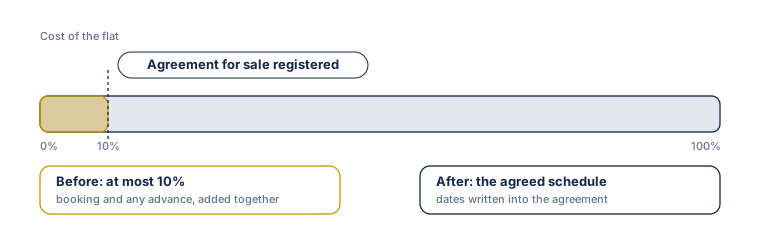
A bar representing the full cost of a flat. The first ten per cent is shaded in gold and labelled as the most you can collect before a registered agreement for sale. A marker at ten per cent shows the agreement being registered. The remaining ninety per cent is labelled as collected on the dates written into that agreement.

Why your booking amount stops at 10%

RERA Section 13 caps what you can take before a registered agreement for sale. A Letter of Intent does not get around it, as one Maharashtra builder found.
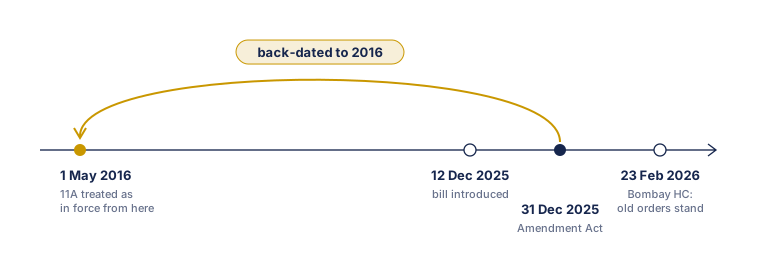
A timeline. The bill was introduced on 12 December 2025, the Amendment Act is dated 31 December 2025 as cited by the Bombay High Court, and on 23 February 2026 the High Court held that earlier deemed conveyance orders stand. A gold arc runs from the Act back to 1 May 2016, the date from which Section 11A is treated as in force.

Deemed conveyance now reaches RERA projects

MOFA's new Section 11A gives allottees in a RERA-registered project a deemed conveyance route, back-dated to 1 May 2016. What it changes for developers.
Three stacked layers: a proposed DELTA token and exchange layer on top involving SEBI, BSE and NSE, the existing land title and registry beneath it, and your day-to-day project operations at the bottom, marked unchanged

Maharashtra's DELTA Act: what it means for your project (for now, nothing)

The CM has asked officials to draft a law on tokenising property. Here is what was actually announced on 20 July, why the committee's make-up matters more than the word blockchain, and why a developer selling under-construction flats can safely ignore it this year.
Two side-by-side flows. On the left, what people picture: a buyer pays, a third party holds the money, and it is released to the developer. On the right, what the Act says: a buyer pays into the developer's own separate account, and three professional certificates are what release it.

The RERA 70% account is not an escrow account

Section 4(2)(l)(D) says 'separate account', never 'escrow'. That word decides who has to be convinced before your own money moves, and it isn't the bank.